
Business Licensing & Regulatory Approvals in Nepal
Industry registration, sector-specific operating licences, EXIM code, ward and municipal registration, and the renewals that keep them valid.
Quick answer
Most businesses in Nepal need more than a company certificate. Manufacturers register their industry with the Department of Industry or the cottage and small industry office, importers and exporters need an EXIM code from the Department of Customs (renewed every year before Ashadh end), every business registers with its ward office, and regulated sectors need a separate licence from their regulator.
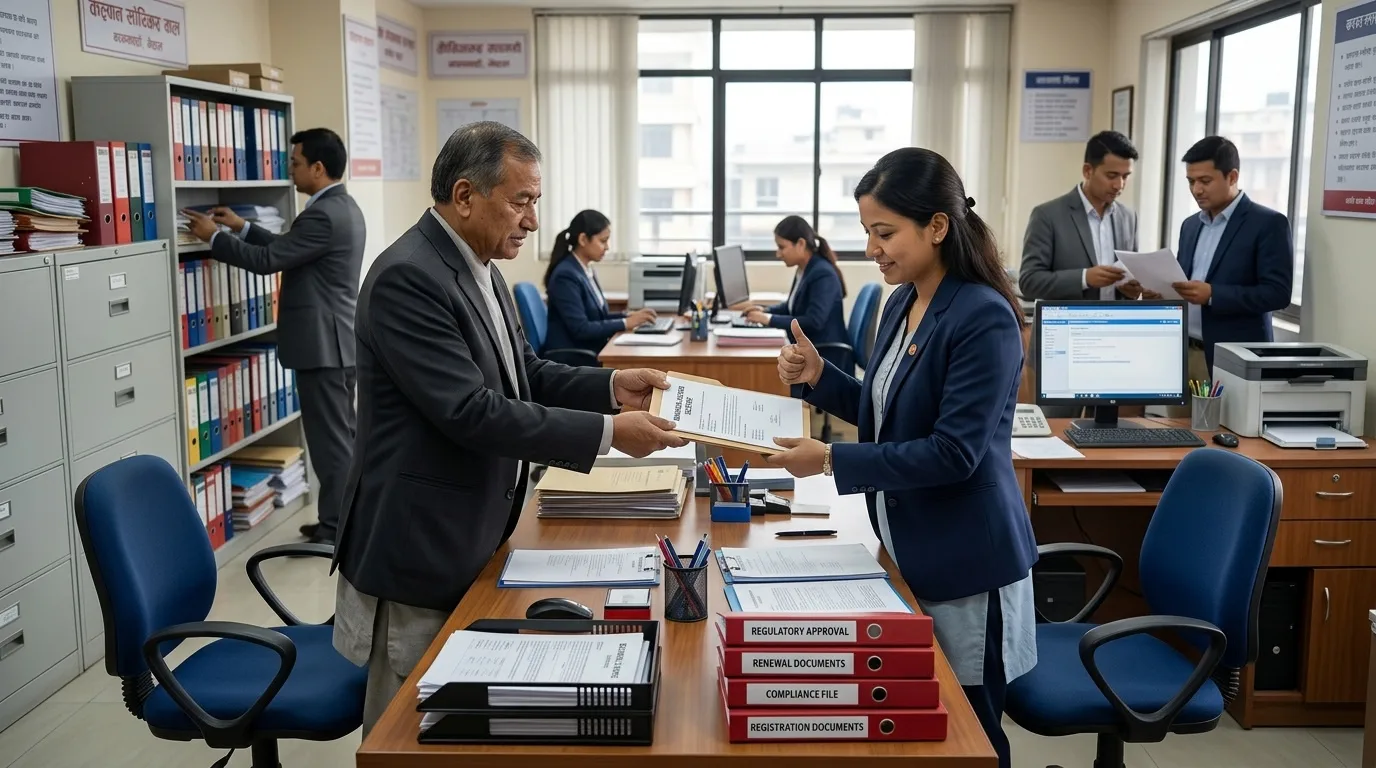
Business Licensing & Regulatory Approvals in Nepal: what you need to know
A company certificate from the OCR proves the business exists; it does not authorise every activity. Before opening its doors, a business may need three more layers of permission: registration of the industry itself if it manufactures or provides industrial services, local registration with the ward office and municipality, and a licence from the specific regulator of its sector.
Which layers apply depends on what you do. A software company may need only ward registration and its tax registrations. A garment factory needs industry registration, environmental clearance appropriate to its size, and an EXIM code to import fabric. A trekking agency needs a licence from the Department of Tourism; a money changer needs Nepal Rastra Bank approval; a pharmacy needs the Department of Drug Administration. Getting the order right matters, because many regulators ask for the company and tax certificates first.
Licences also expire. EXIM codes are renewed each fiscal year, ward registrations and many sector licences are renewed annually, and industries must report changes in capital or location. Missed renewals lead to fines, blocked customs clearance or problems at the bank. We maintain a renewal calendar for clients so nothing lapses.
If you have not registered the company yet, start with our company incorporation service. Foreign-owned businesses also need FDI approval from the Department of Industry before incorporation, which we coordinate in the same engagement.
Which licence does your business need?
| Business | Typical approvals after company and PAN registration |
|---|---|
| Manufacturing / production | Industry registration (DOI or cottage & small industry office), environmental study as required, EXIM code for imports, ward registration |
| Import / export trading | EXIM code via NNSW, ward registration, VAT registration (compulsory for importers) |
| IT, software and online services | Ward registration; industry registration where the activity is classed as an industry; VAT from the first sale for software companies |
| Travel, trekking and tour operators | Licence from the Department of Tourism, plus membership and insurance requirements |
| Money exchange, remittance, payments | Licence or approval from Nepal Rastra Bank |
| Pharmacy and medical supplies | Registration with the Department of Drug Administration |
| Schools, colleges, training institutes | Permission from the education authority or local government, depending on level |
| Restaurants, cafés and hotels | Ward/municipal registration; tourism classification for hotels; food safety requirements |
This is a starting point, not an exhaustive list. Requirements vary with capital, location and the exact activity in your objectives — we confirm them for your case before you invest.
Industry registration under the Industrial Enterprises Act 2076
An industry is registered according to its size and type. Larger industries and foreign-invested industries are registered with the Department of Industry; cottage, micro and small industries are registered with the cottage and small industry offices or the provincial or local body designated for them. The application describes the products or services, fixed and working capital, location, production capacity, power and raw-material needs, and employment.
Registration gives access to the facilities and incentives available under the Act and is often a prerequisite for customs concessions on machinery. It also brings duties: annual reporting, approval for changes in capital or location, and compliance with environmental and labour rules — our guide for employers under the Labour Act covers the staffing side.
EXIM code: the licence to import and export
Any business that imports or exports goods commercially needs an EXIM code issued by the Department of Customs through the Nepal National Single Window. The application uses the company registration certificate, PAN/VAT certificate, directors' identification and bank details.
The code number itself is permanent, but its validity is renewed every fiscal year before the end of Ashadh. Customs will not clear shipments against an expired code, and a code left unrenewed for several consecutive years can be cancelled. We file new applications and annual renewals and keep the reminder in your compliance calendar.
Why business licensing exists
A licence gives your business legal recognition and lets the government check compliance, collect revenue, protect consumers, plan land use and bring businesses into the formal economy — which in turn opens access to bank finance and government support.
| Authority | Role |
|---|---|
| Department of Industry (DOI) | Industry registration, foreign investment, trademarks |
| Office of Company Registrar (OCR) | Company incorporation and records |
| Department of Commerce, Supplies and Consumer Protection | Private and partnership firms, trade and consumer protection |
| Municipality / rural municipality | Location-specific business registration and renewals |
| Nepal Rastra Bank | Banks, financial institutions, money exchange and payments |
| Sector regulators | Tourism, health, education, Nepal Telecommunications Authority and others |
Industry size classes
| Class | Criteria |
|---|---|
| Micro enterprise (लघु उद्यम) | Fixed capital up to NPR 20 lakh (excluding land and building), up to 9 workers including the entrepreneur, annual transactions under NPR 1 crore, machinery up to 20 kW |
| Cottage industry (घरेलु उद्योग) | Based on traditional skills and local resources, labour-intensive, machinery within the limit set by the Act (up to 50 kW) |
| Small industry (साना उद्योग) | Fixed capital up to NPR 15 crore (other than micro and cottage) |
| Medium industry (मझौला उद्योग) | Fixed capital above NPR 15 crore up to NPR 50 crore |
| Large industry (ठूला उद्योग) | Fixed capital above NPR 50 crore |
Fees, renewals and the document list for smaller units are in our cottage and small industry guide. Check your class with the industry class and fee calculator.
How long a business licence takes
| Stage | Usual time |
|---|---|
| Preparing documents | 1–2 weeks |
| Submission and initial review | 1–2 weeks |
| Clearances from other departments | 2–4 weeks |
| Final review and approval | 1–2 weeks |
| Licence issued | About 1 week |
| Total | Around 5–11 weeks |
Complex applications or those needing extra clearances (for example an environmental study) can take longer. Quick replies to queries shorten the process.
Business licence checklist
- 1
Identify the exact licence
Research which licences apply to your activity and location.
- 2
Gather the documents
Application form, company certificate, MOA/AOA, PAN, tax clearance, directors' citizenship or passports, lease or ownership proof, EIA report if required, sector certificates, and bank statements or proof of funds.
- 3
Obtain clearances
Get recommendations or clearances from the departments involved.
- 4
Pay fees and submit
Pay application, registration and sector fees and submit the complete package.
- 5
Follow up and attend inspections
Respond to queries and be present for any interview or site inspection.
- 6
Review the licence and plan renewals
Check the conditions on the licence and diary every renewal date.
Compliance after you get the licence
- Annual financial audit and accurate financial reporting.
- Tax filings and payments on time.
- Renewal of licences and permits before they expire — including the EXIM code renewal before Ashadh end.
- Updating company information with the OCR whenever it changes.
- Following labour and environmental rules.
Laws involved include the Industrial Enterprises Act 2076, Foreign Investment and Technology Transfer Act 2075, Companies Act 2063, Income Tax Act 2058 and Labour Act 2074. Failing to keep up can lead to penalties, revocation of the licence or legal action.
What our licensing service includes
- 01Licence mapping for your exact business activity
- 02Industry registration with the DOI or cottage & small industry office
- 03EXIM code registration and yearly renewal on NNSW
- 04Ward and municipal business registration and renewal
- 05Sector licences: tourism, NRB, DDA, education and others
- 06Changes in capital, location or objectives of an industry
- 07Renewal calendar and reminders for every licence
- 08EXIM code de-registration when you stop trading
- 09Business winding-up support
- 10Tax clearance and documents needed for renewals
How we secure your licences
- 01
Licence map
We list every registration and permit your activity needs, in the order the offices require them.
- 02
Document pack
We prepare applications, project descriptions and supporting documents for each office.
- 03
Filing and follow-up
We submit online or in person and respond to queries and inspections.
- 04
Renewals
We track expiry dates and renew before deadlines so operations are never interrupted.
Documents to keep ready
- Company registration certificate, MOA and AOA
- PAN/VAT certificate
- Directors' citizenship or passport copies
- Lease agreement and details of the business premises
- Project description: products, capacity, capital and staff
- Sector-specific documents (qualifications, insurance, bank guarantee) where required
Why clients choose Company Services Nepal
We work out the full licence path before you sign a lease or import machinery.
One team handles company, tax and licence steps, so documents match across offices.
Renewal tracking for EXIM, ward and sector licences.
Clear answers on what each regulator will ask for, based on day-to-day filing work.
Business Licensing & Regulatory Approvals in Nepal: frequently asked questions
Is a company registration certificate the same as a business licence?
No. The OCR certificate creates the company. Operating permission comes from ward registration, industry registration where relevant, and any licence your sector requires.
Who needs an EXIM code in Nepal?
Businesses that import or export goods commercially — trading companies, manufacturers importing raw materials, and exporters. Service businesses that never move goods across the border normally do not need one.
What happens if I forget to renew my EXIM code?
Customs will not clear goods against an expired code. Renew before the end of Ashadh each year; codes left unrenewed for a long period can be cancelled and must be applied for again.
Does an IT or software company need industry registration?
It depends on the activity and size. Many software and IT service companies operate with company, PAN/VAT and ward registration, while some IT activities are classified as industries. We check your objectives against the current classification.
Can a foreign-owned company get these licences?
Yes, in sectors open to foreign investment. Foreign-owned businesses first obtain FDI approval, then follow the same licensing steps as a Nepali company.
How long does ward registration take?
Usually a few working days once you have the company certificate, PAN and lease documents. Fees and exact requirements are set by each municipality.
Sources and official references
- Department of Industry, Nepal
- Department of Customs, Nepal
- Nepal National Single Window (NNSW)
- Industrial Enterprises Act 2076 — Nepal Law Commission
Government fees and rules change with each Finance Act and OCR/IRD notice. We re-check the figures on this page regularly; confirm the latest amount with the office concerned or ask our team before you pay.
Related guides and services
Let's get started
Ready to register your company?
Free 30-minute consultation — a roadmap, transparent pricing, and a start date the same week.